
DuPage County Circuit Court Overview
Illinois voters unified the state's trial courts in 1964. Before that, the state had circuit, county, probate, municipal, city, village, justice of the peace, and police magistrate courts running side by side. After unification, the Circuit Court became the only trial court of original jurisdiction. DuPage is the 18th Judicial Circuit, and the state lists it as one of the single-county circuits. The court hears every kind of state trial matter for the residents of Wheaton, Naperville, Aurora, Downers Grove, Elmhurst, and the rest of DuPage County.
The state's official site confirms the structure. The Illinois Courts circuit court page says circuit courts share concurrent jurisdiction with the Supreme Court in revenue, mandamus, prohibition, and habeas corpus matters when the Supreme Court chooses to exercise its authority, and that circuits also review certain administrative orders.
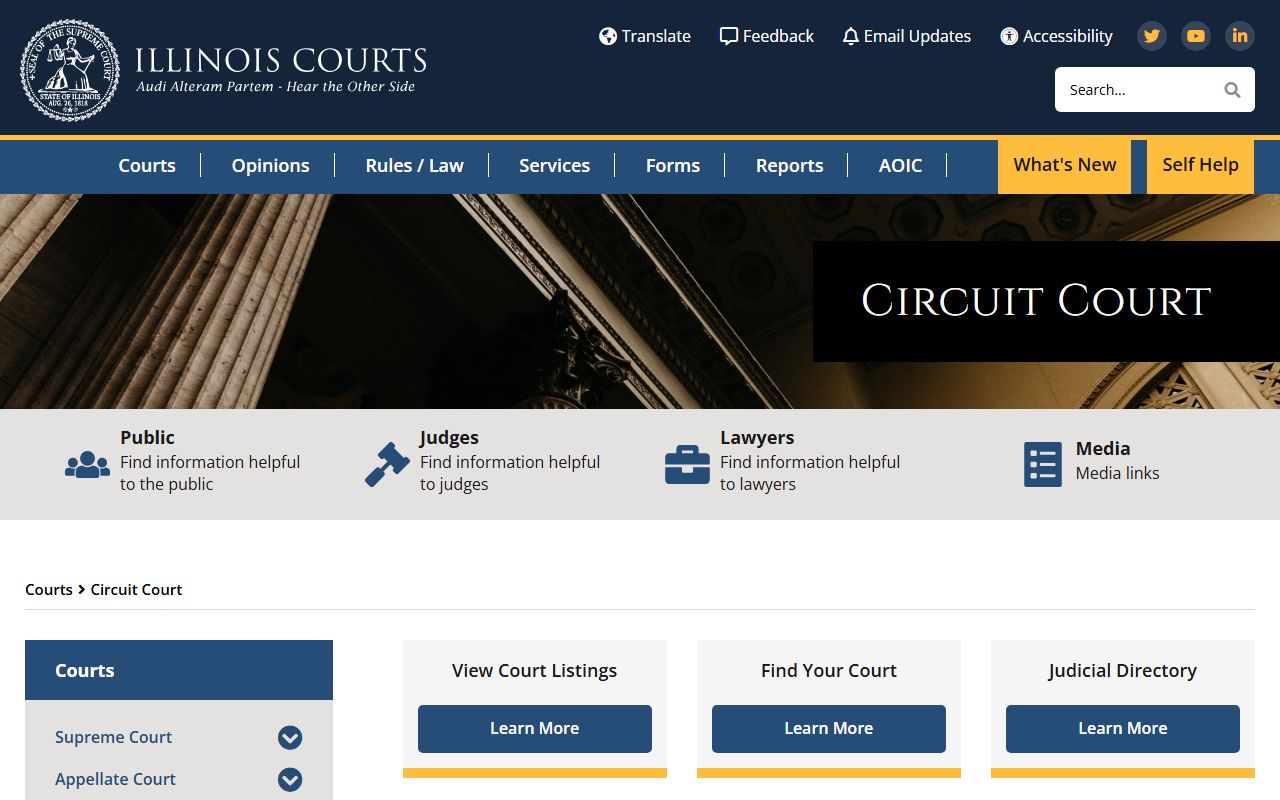
Circuit judges are elected for six-year terms and can hear any matter that comes before the circuit. Associate judges are appointed by the circuit judges for four-year terms and handle assignments from the Chief Judge or a designated circuit judge.
Divisions of the DuPage County Circuit Court
The 18th Judicial Circuit does not split into numbered district courts the way Texas or some other states do. DuPage Circuit Court instead works by case-type division, with judges assigned to a department by the Chief Judge. The Mandatory Arbitration Program sits on the third floor of the Judicial Center and handles small claims jury proceedings plus civil money cases above $10,000 and below the Supreme Court-approved circuit limit.
| Division | Case Types | Location | Phone |
|---|---|---|---|
| Civil / Law | Lawsuits over $10,000, contracts, personal injury, debt | DuPage County Courthouse, 505 N. County Farm Road, Wheaton | (630) 407-8700 |
| Criminal & Traffic | Felony, misdemeanor, DUI, traffic citations | 505 N. County Farm Road, Wheaton | (630) 407-8600 |
| Domestic Relations / Family | Divorce, parenting, support, orders of protection | 505 N. County Farm Road, Wheaton | (630) 407-8700 |
| Probate Division | Estates, wills, guardianships, claims | 505 N. County Farm Road, Wheaton | (630) 407-8700 |
| Chancery | Foreclosure, injunctions, administrative review | 505 N. County Farm Road, Wheaton | (630) 407-8700 |
| Small Claims / Civil Municipal | Money cases at or under $10,000, evictions, consumer debt | 505 N. County Farm Road, Wheaton | (630) 407-8700 |
| Juvenile | Delinquency, abuse, neglect, dependency | 505 N. County Farm Road, Wheaton | (630) 407-8700 |
| Mandatory Arbitration | Civil money cases above $10,000 within program limits | Judicial Center, 3rd floor | (630) 407-8901 |
Each division feeds into the same Circuit Clerk file. Case-type letters on the case number help the reader identify the division: CF for felony, CM for misdemeanor, TR for traffic, D for dissolution, P for probate, LA for civil law, LM for civil municipal, SC for small claims, CH for chancery, JA for juvenile abuse, JD for juvenile delinquency, and MR for miscellaneous remedy.
Circuit Court vs. Municipal Hearings vs. Federal District Court
Illinois does not have separate county courts or justice of the peace courts. Cities and villages run administrative hearing systems for parking, code, and ordinance matters, but those are not part of the Circuit Court. Federal civil and criminal cases that arise in DuPage are heard in the U.S. District Court for the Northern District of Illinois, not the Circuit Court.
| DuPage Circuit Court | Municipal Administrative Hearings | U.S. District Court, N.D. Illinois | |
|---|---|---|---|
| Civil Jurisdiction | All civil matters, including over $10,000 | Local ordinance, parking, code only | Federal civil and diversity cases |
| Criminal Jurisdiction | Felonies, misdemeanors, traffic, juvenile | Ordinance fines only, not criminal | Federal crimes, including drug, firearm, fraud |
| Family Cases | Yes, full divorce and parentage docket | No | No |
| Appeal Route | Illinois Appellate Court, Third District | Circuit Court administrative review | U.S. Court of Appeals for the Seventh Circuit |
The federal court keeps its own docket. The U.S. District Court for the Northern District of Illinois publishes filing rules, judge assignments, and access information that do not overlap with the DuPage Circuit Clerk's case file.
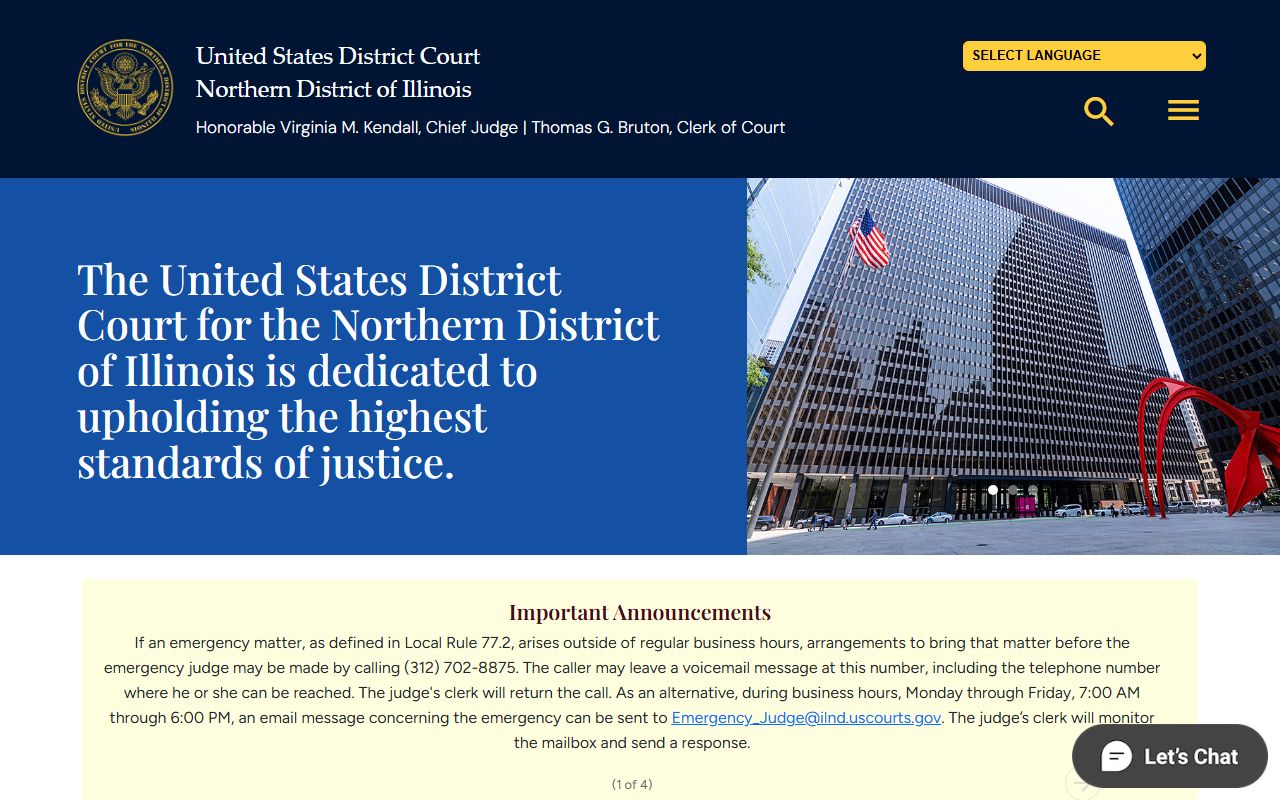
Federal cases tie into the national PACER system rather than the Circuit Clerk's Public Information Application.
How a Case Moves Through the DuPage County System
Most cases follow a predictable path through the Circuit Court. A criminal matter usually begins with an arrest or a complaint, moves through bond and a first appearance, then to preliminary hearing or indictment, arraignment, pretrial conferences, trial, sentencing, and possible appeal. A civil matter begins with the petition or complaint, then the answer, discovery, motion practice, possible arbitration or mediation, trial, judgment, and post-judgment collection or appeal.
Criminal flow: Arrest › First Appearance › Preliminary Hearing or Indictment › Arraignment › Pretrial › Trial › Sentencing › Appeal
Civil flow: Complaint or Petition Filed › Answer › Discovery › Mediation or Arbitration › Trial › Judgment › Appeal
The federal court for DuPage runs a similar arc on the federal side. Documents in those cases live in the federal CM/ECF system. The CM/ECF portal for the Northern District of Illinois is the official electronic filing system for federal cases that arise in DuPage.
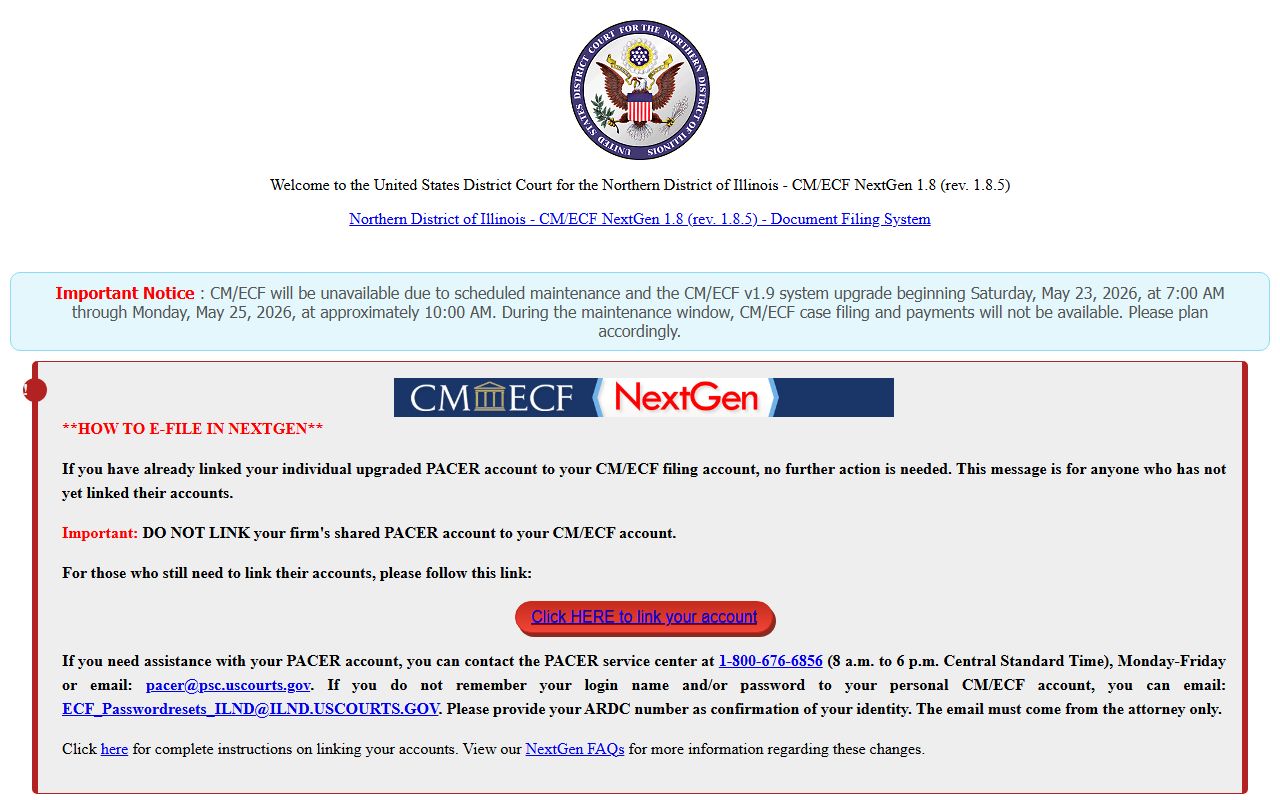
Federal filings cannot be searched through the DuPage Circuit Clerk; PACER accounts are required for most public access.
Civil, Family, and Criminal Departments
The Circuit Clerk staffs separate counters for civil, criminal, traffic, family, probate, and small claims work. The Civil Department answers calls at (630) 407-8700 and processes most civil filings, including chancery and law cases. The Criminal and Traffic Department answers at (630) 407-8600 and handles felony, misdemeanor, DUI, and traffic citation matters. Family-law filings, orders of protection, and parenting motions also route through the courthouse counters under the supervision of the Domestic Relations division.
Specialty resources sit on the same campus. The DuPage Law Library on the second floor of the Judicial Center serves about 35,000 to 40,000 patrons each year and offers self-help materials, free reference assistance, and e-filing kiosks. The Safe Harbor children's waiting room was listed as temporarily closed for COVID-19 precautions in the state's directory entry; check before relying on it.
The 18th Judicial Circuit
DuPage County is the 18th Judicial Circuit. Trial Court Administrator Suzanne Armstrong is listed in the official state court directory for the courthouse, with the main administrative line at (630) 407-8901. The Chief Judge of the 18th Judicial Circuit oversees assignment of judges to divisions, sets local rules, and signs administrative orders. The 18th Judicial Circuit's official website publishes judicial assignments, administrative orders, press releases, and program announcements.
In 2025 the Circuit hosted one of two Illinois Tuition-Free Official Court Reporter Training Program sites. Classes begin in September 2025, run for two years, and graduates receive guaranteed job placement after certification with a two-year employment commitment. The announcement is one example of how the 18th Judicial Circuit invests in court-record infrastructure beyond day-to-day case work.
Lower Forums and Local Hearings
Illinois does not run a state-level lower trial court below the Circuit Court. Local cities and villages may run administrative hearing systems for ordinance violations, parking, and code enforcement. Those forums are not part of the Circuit Court file. A person with a parking ticket from Wheaton, Naperville, or Lombard usually pays or contests the citation at city hall, not at the County Farm Road courthouse. Disputes about an administrative ruling may end up in the Circuit Court's administrative review docket if state law allows.
Note: The Pretrial Fairness Act changed how Illinois handles pretrial release; most release decisions in DuPage Circuit Court now follow a judicial hearing rather than a cash-bond schedule.