
How to Search DuPage County Court Records
The Office of the Clerk of the 18th Judicial Circuit Court keeps the trial-court file for every case heard in DuPage County. The public search front end is the Circuit Clerk's Public Information Application, which lets a user look up case status, find the next court date, read docket entries, pay a traffic ticket or civil law violation, register for traffic email updates, and submit an address change. The portal is gated by a Cloudflare Turnstile check that the user must clear before searching. If the check will not pass, the public information terminals at the Circuit Clerk's office at 505 N. County Farm Road in Wheaton are the next step. Attorneys, police agencies, and self-represented litigants who need deeper access can request a free account through the Circuit Clerk's eAccess restricted information system; review usually finishes in two business days.
The official Public Information Application is the first stop for most public users. The link below opens the same Circuit Clerk landing page used to pay tickets and view a case file.
The Circuit Clerk's Public Information Application is the searchable case-lookup portal for DuPage trial cases.
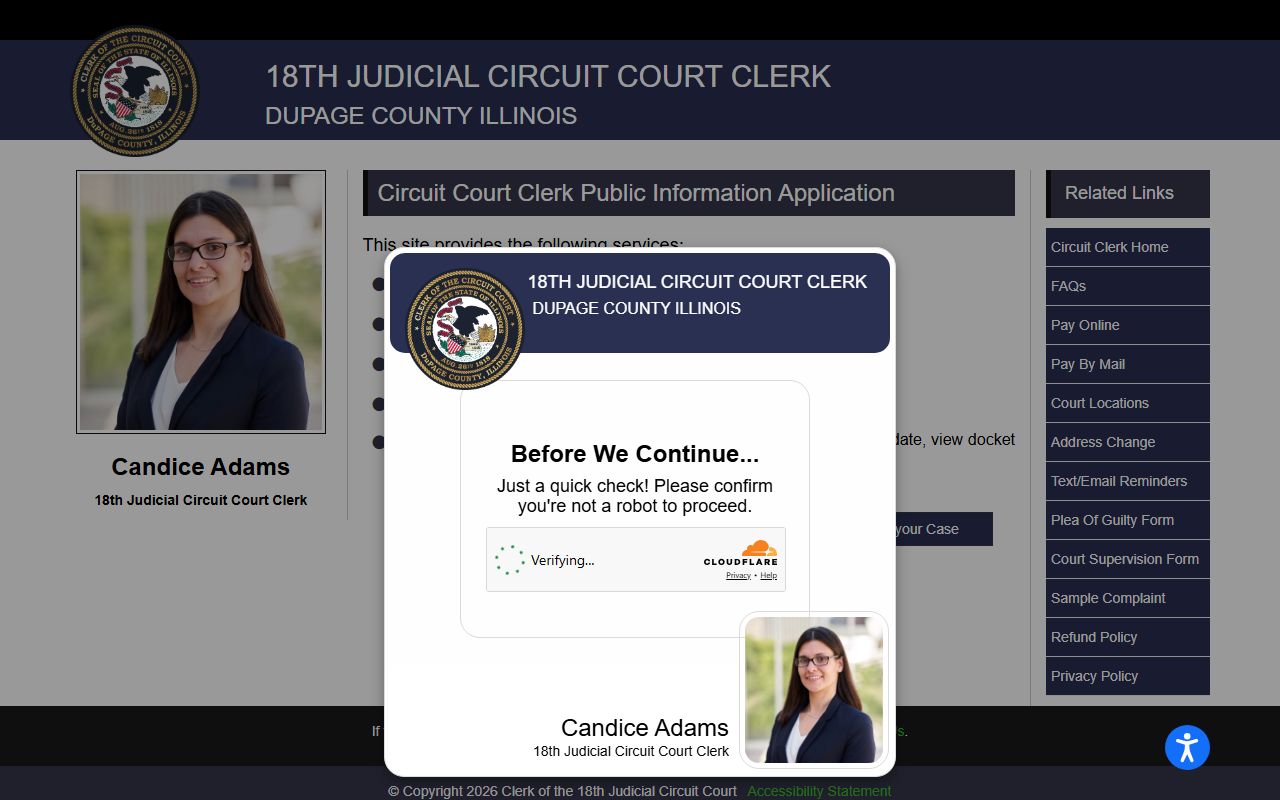
The landing page identifies Candice Adams, Clerk of the 18th Judicial Circuit Court, and lists the search and payment paths a public user can take. Have a name, case number, or citation number ready before the search begins.
- Open the Public Information Application and clear the Cloudflare verification check.
- Choose the search or payment path that matches the case type, such as traffic, civil, criminal, or family.
- Enter a party name, case number, or citation number, then narrow by date or court type if needed.
- Open the case detail to see next court date, courtroom, docket entries, and balance due.
- For sealed, juvenile, or older paper files, visit the Clerk's public terminals at 505 N. County Farm Road in Wheaton or request a certified copy.
The Circuit Clerk also publishes a registered-user system for attorneys, police agencies, and pro se filers. The Circuit Clerk's eAccess login page explains who can request an account and what it covers.
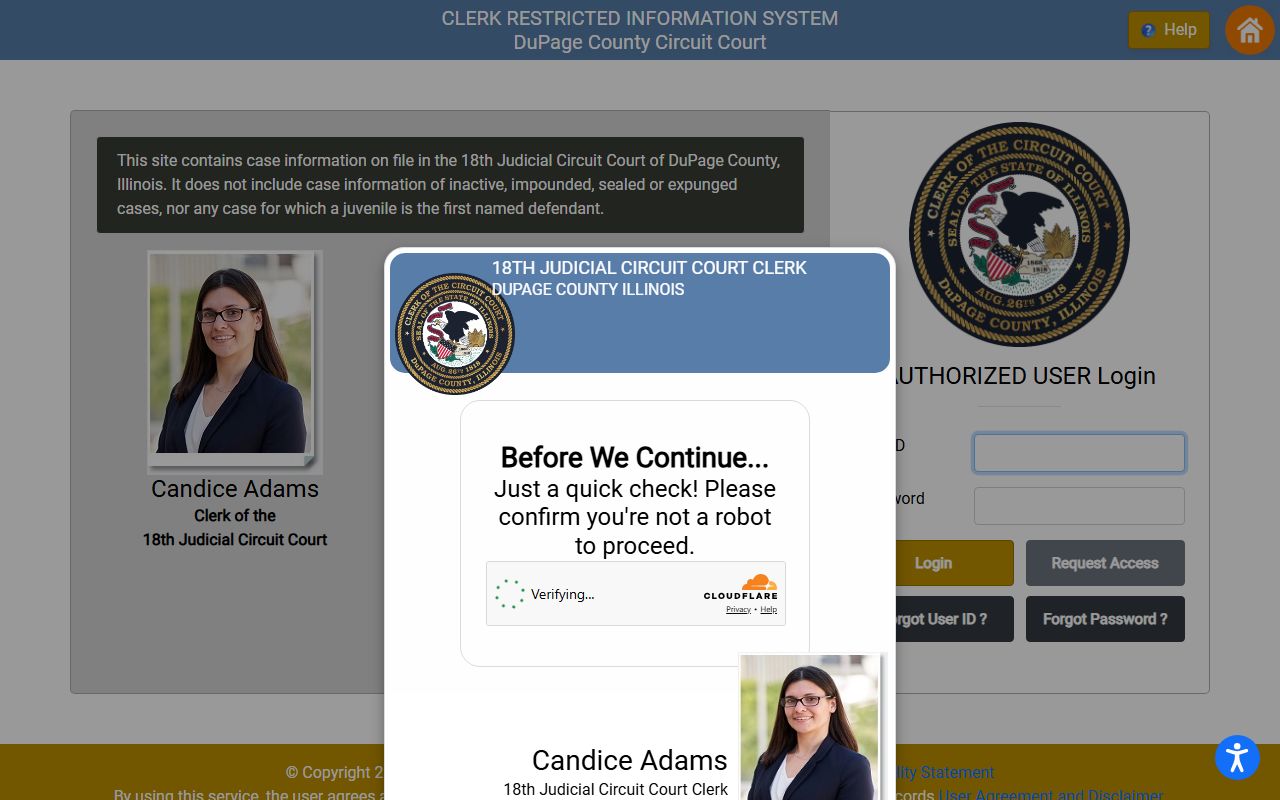
eAccess covers active, non-confidential circuit cases. It does not include inactive, impounded, sealed, expunged, or juvenile-first-named-defendant files.
The DuPage County Judicial System
Illinois unified its trial courts in 1964. Before the change, the state had a patchwork of circuit, county, probate, municipal, city, village, justice of the peace, and police magistrate courts. After the amendment, the Circuit Court became the single trial court of general jurisdiction. DuPage County is the 18th Judicial Circuit, one of the single-county circuits the state created during redistricting. Trial-level matters in DuPage are heard by circuit judges and associate judges who sit at the DuPage County Courthouse in Wheaton.
Circuit judges in Illinois are elected for six-year terms and can hear any matter that comes before the circuit. Associate judges are appointed by circuit judges for four-year terms and hear cases the Chief Judge or designated circuit judge assigns. Voters also elect the Circuit Clerk for a four-year term. Appeals from DuPage trial-court orders move to the Illinois Appellate Court, Third District, and may go on to the Illinois Supreme Court if review is granted.
Case flow: Circuit Court › Illinois Appellate Court, Third District › Illinois Supreme Court
| Court | Role | Case Types |
|---|---|---|
| 18th Judicial Circuit Court | Trial court of original jurisdiction for DuPage County | Civil, criminal, traffic, family, juvenile, probate, chancery, small claims |
| Illinois Appellate Court, Third District | Intermediate appellate court | Appeals from final DuPage trial-court orders |
| Illinois Supreme Court | Highest state court | Discretionary review, rulemaking, attorney discipline |
| U.S. District Court, Northern District of Illinois | Federal trial court covering DuPage | Federal civil and criminal cases, not state circuit cases |
The state confirms this structure on its official page. The Illinois Courts circuit court page explains that circuit courts have jurisdiction over all matters properly brought before them, with narrow exceptions in the Illinois Constitution.
DuPage County Courthouse in Wheaton
The trial court, Circuit Clerk, Sheriff, County Clerk, and county administration sit together on the DuPage County Government Campus along County Farm Road in Wheaton. Most court-record errands in DuPage start at one of three buildings on that corridor. The state directory entry for the courthouse confirms address, hours, parking, and on-site amenities.
The state court directory lists the courthouse details. The Illinois Courts DuPage directory entry names Trial Court Administrator Suzanne Armstrong, hours 8:00 a.m. to 4:30 p.m., phone (630) 407-8901, and free parking in two garages and several flat lots.
The directory also notes a first-floor cafeteria, a second-floor Law Library, e-filing kiosks at the County Clerk's office or the Law Library, and a Pace bus stop on the north side of the campus.
Circuit Court Clerk
505 N. County Farm Road
Wheaton, IL 60187-0707
Civil (630) 407-8700
Sheriff & Correctional Facility
501 N. County Farm Road
Wheaton, IL 60187
(630) 682-7256
Types of Court Records Available in DuPage County
The Circuit Clerk says the office takes in more than 150,000 case filings each year. Those filings break down into the same record types other Illinois circuits handle. Some are open to anyone with a name or case number. Others are sealed, impounded, juvenile, or otherwise blocked from public view. The overview at the Circuit Clerk's Circuit Clerk overview page lists the filing categories the office tracks.
A short walkthrough of what each category covers helps a first-time researcher pick the right search tool. The Public Information Application searches active circuit cases. Older paper or microfilm files are pulled at the Clerk's public terminals.
- Criminal records - Felony, misdemeanor, and criminal traffic cases tracked by the Circuit Clerk. See DuPage criminal records for the deeper walkthrough.
- Civil records - Lawsuits, money judgments, evictions, and small claims. Searched through the Public Information Application.
- Family records - Divorce, parental responsibility, child support, and orders of protection. See marriage and divorce records.
- Probate records - Estates, wills, and guardianships heard in the Probate Division of the Circuit Court.
- Traffic records - Citations, supervision, and traffic dispositions covered on the traffic court records page.
- Juvenile records - Delinquency and abuse/neglect cases under the Juvenile Court Act, restricted from most public access.
What DuPage County Court Records Show
A typical DuPage County Court file holds a case number, a caption that names the parties, a filing date and case type, the assigned judge, courtroom, next court date, docket entries, and any orders or judgments the court has signed. Criminal files add the charge or charges, bond and pretrial release conditions, a plea, sentencing data, and any warrants. Family files add petitions, parenting plans, and support orders. Civil files add complaints, summonses, answers, and post-judgment collection events.
| Field | What It Shows |
|---|---|
| Case Number | Year-and-type code, such as a CF for felony or a TR for traffic, plus a sequence number. |
| Filing Date | Date the Clerk stamped the first pleading in the case. |
| Parties | Plaintiff or petitioner versus defendant or respondent, plus listed attorneys. |
| Charges / Cause | Criminal counts, civil cause of action, or family relief sought. |
| Disposition | Verdict, plea, dismissal, supervision, or judgment. |
| Sentence / Judgment | Fines, costs, probation, jail, or money damages. |
| Docket Entries | Date-stamped log of motions, hearings, orders, and notices. |
| Next Court Date | Scheduled hearing or status date, with courtroom number. |
Note: Personal identifiers such as Social Security numbers, financial account numbers, dates of birth, and minor names are redacted from the public view of a DuPage County Court record.
Public Access Laws for DuPage County Court Records
Public access to a DuPage County Court file rests on three things: the Illinois Freedom of Information Act, the Illinois Supreme Court rules that govern court records, and the local administrative orders of the Chief Judge of the 18th Judicial Circuit. FOIA applies to most public bodies. Court files run on their own track and are controlled mainly by Supreme Court Rule 8 and the state Electronic Access Policy. The Circuit Clerk follows both. The court records page at the Clerk's office says all records except those impounded or sealed by statute or court order are open to the public during business hours.
Key Statutes and Rules:
5 ILCS 140, Illinois Freedom of Information Act - Public bodies must respond to record requests within statutory time frames.
Illinois Supreme Court Rule 8, Case and Document Accessibility - Presumes court documents are accessible unless a confidentiality classification applies.
20 ILCS 2630/5.2, Criminal Identification Act - Governs expungement and sealing of qualifying arrest and court records.
Illinois Supreme Court Electronic Access Policy - Sets remote access rules for clerk-held court records.
Public access on a phone or a laptop is narrower than the access a person gets at the Clerk's window. The Electronic Access Policy and Rule 8 limit what is published online for privacy and safety reasons. Public terminals at the Clerk's office fill the gap when a remote search will not show a file.
Records That Are Restricted or Confidential
The Clerk's court records page says all DuPage files are public except those impounded or sealed by statute or court order. The most common restricted categories are juvenile delinquency cases, adoption files, mental health proceedings, sealed search warrants, sealed criminal records, expunged arrests, and family files with sensitive financial or minor-child data. Orders of protection may also redact the protected party's address.
People who want a sealed or expunged DuPage record reopened must file a petition in the case where the records were closed. The Circuit Clerk hosts a free DuPage County Expungement Clinic that pairs volunteer attorneys with eligible residents to prepare petitions and walk them through filing.
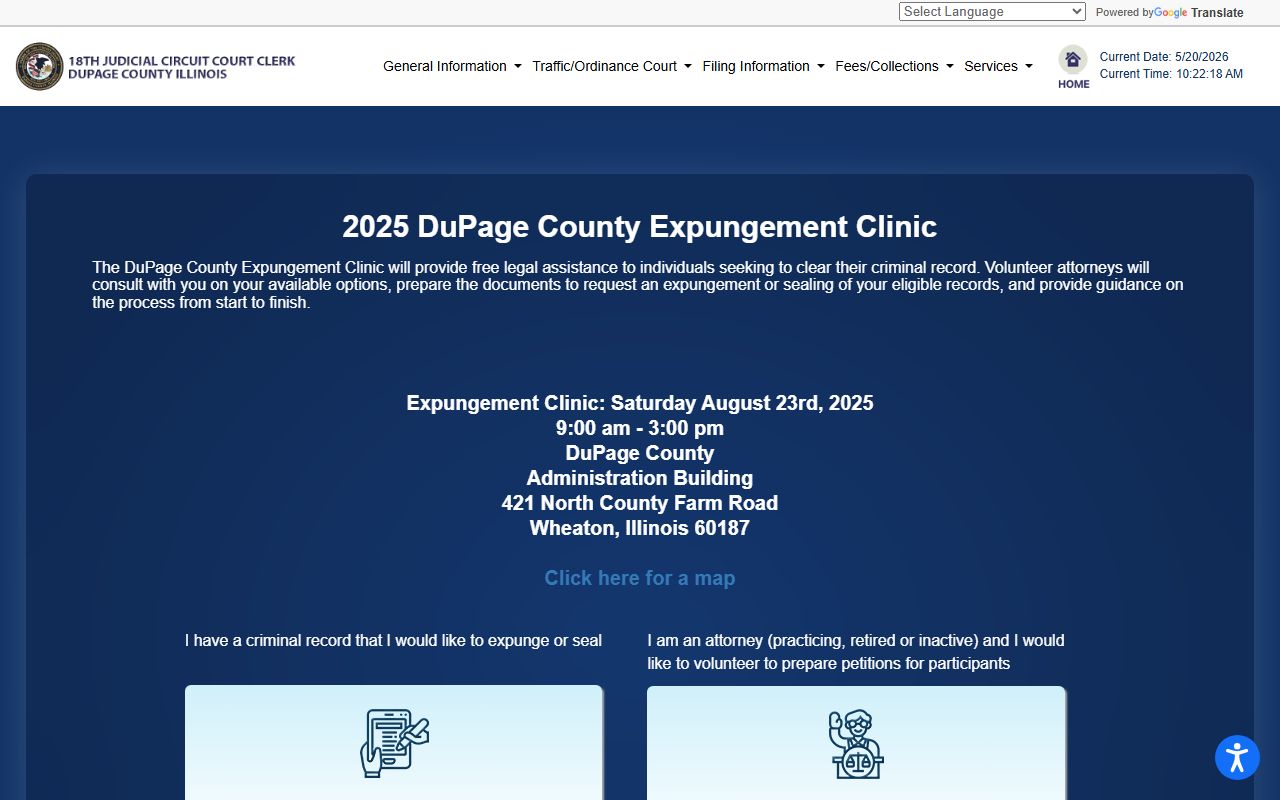
The clinic typically takes place at the County Administration Building. The 2025 clinic ran a full day with no fee to attend or to file the resulting paperwork with the court.
Specialty Programs in DuPage County
The 18th Judicial Circuit lists the Mandatory Arbitration Program on the third floor of the Judicial Center. It hears small claims jury proceedings and civil money-damage cases above $10,000 but under the Supreme Court-approved circuit limit. Mandatory Arbitration shortens the route to a hearing in civil cases that would otherwise wait for a trial date.
On the corrections side, the Sheriff partners with J.U.S.T. of DuPage and runs Mental Health Reentry, Recovery Program, Medicated Assisted Recovery, Periodic Imprisonment, PREA, S.W.A.P., and Veterans Mental Health support. These are not court divisions, but they shape how the court handles defendants who need treatment or reentry help. The Clerk's free expungement clinic, the Law Library self-help center, and the Court Disability Coordinator are the other points where DuPage routes people to programs outside the usual case docket.
DuPage County Sheriff and Jail
The DuPage County Sheriff, James Mendrick, runs the jail and the warrants division from 501 N. County Farm Road in Wheaton. The Sheriff's site bundles inmate, visitation, mail, bond, warrant, and reentry pages under a single Corrections Bureau menu, with a public roster link that goes to the JailTracker system. The Sheriff's home page is the starting point for any custody question in DuPage.
The Sheriff's menu also links the Records Division, FOIA office, VINE notification, and the registered sex offender resource. The full roster details are on the DuPage County inmate records page. For outstanding warrants, see the warrant records page.
Visitation is scheduled online through the Sheriff's video provider. The jail visitation page lists the days, times, and rules.
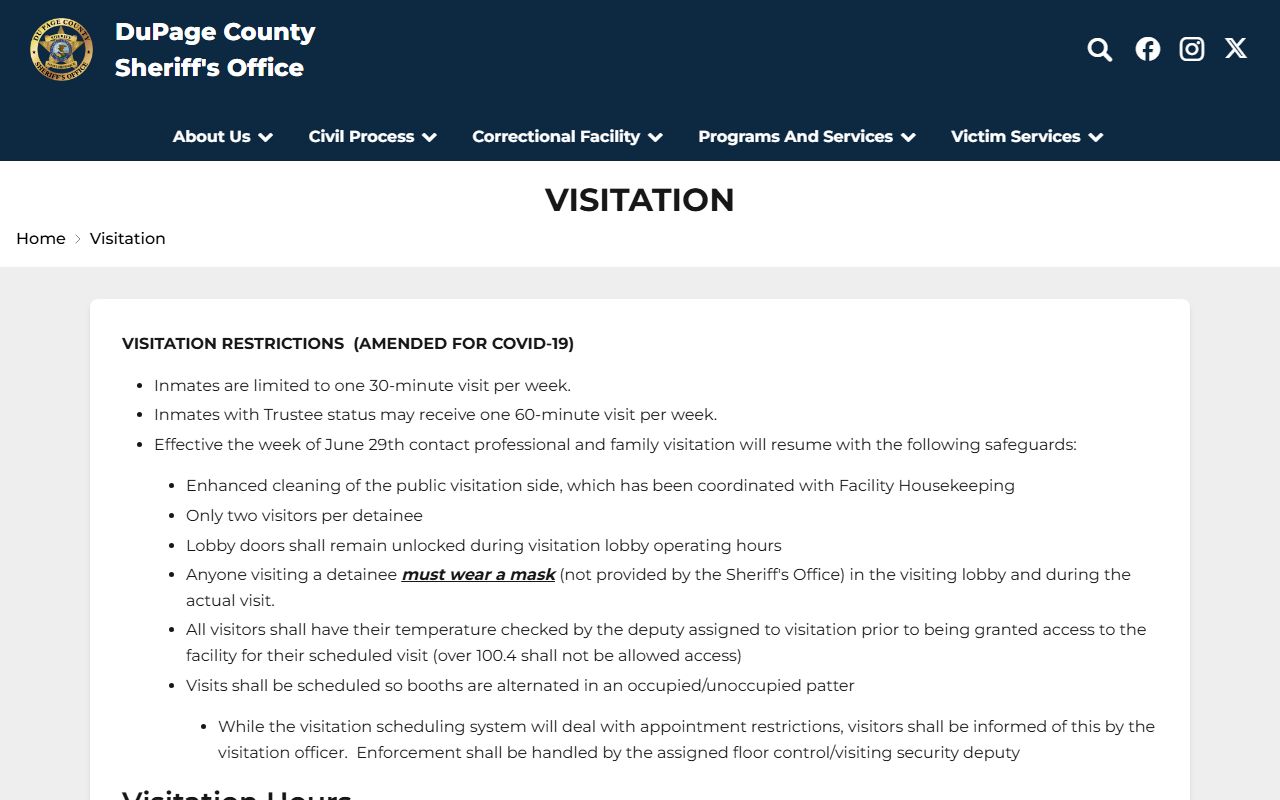
Visits must be scheduled at least one day in advance and not more than 10 days ahead, and check-in starts 15 minutes before the appointment.
People posting bond or surrendering on an active matter should review the official guidance first. The Sheriff's posting bond page covers what to bring and where to report.
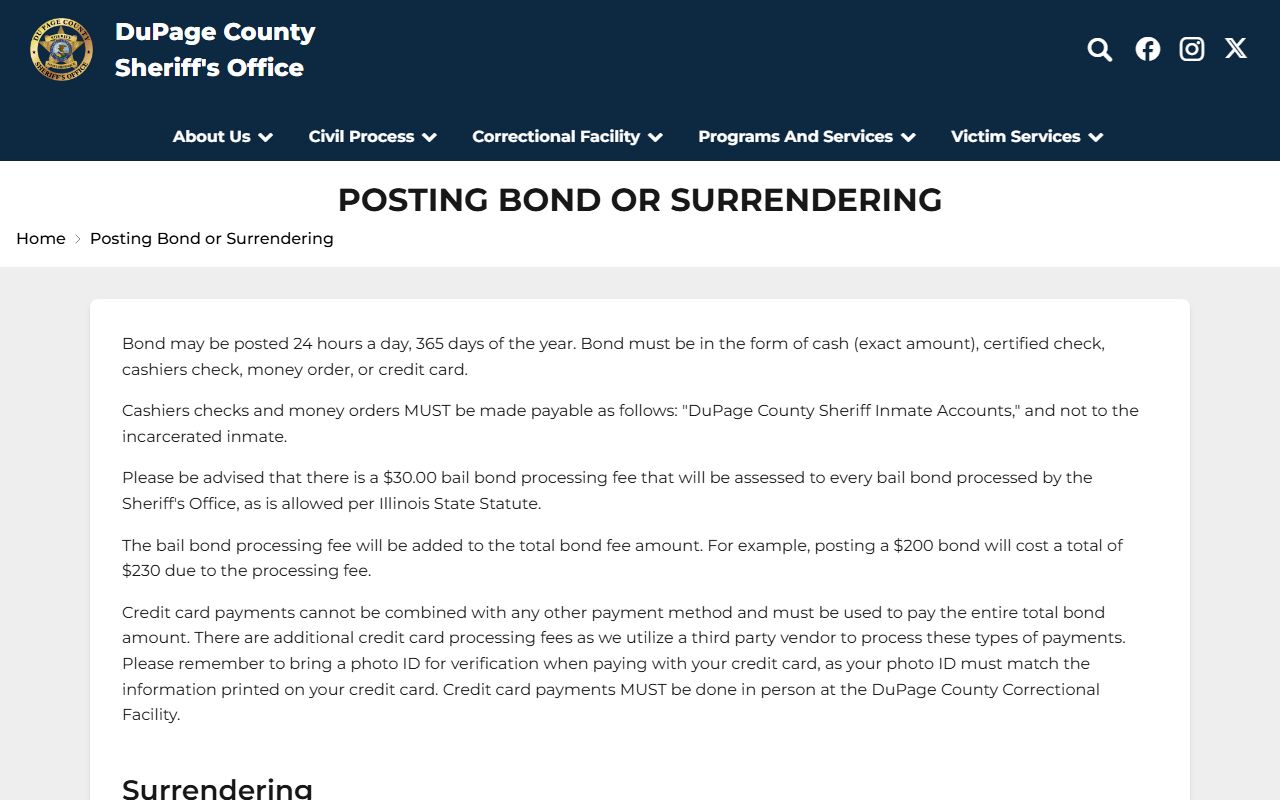
The Pretrial Fairness Act changed how cash bond works in Illinois, and most release decisions now turn on a court hearing rather than a simple cash deposit.
Marriage, Divorce, and Probate Records
DuPage splits family-record work between two offices. Marriage licenses and certified marriage copies are issued by the DuPage County Clerk. Divorce and probate cases are filed in the Circuit Court and the file is kept by the Circuit Clerk. Anyone needing a certified divorce decree should ask the Circuit Clerk, not the County Clerk. The marriage and divorce records page walks through both routes, and the probate records page covers estate and guardianship files.
- Testator
- A person who has made a valid will.
- Executor
- Person named in a will to administer the estate.
- Intestate
- Status of dying without a valid will, which sends the estate through default heirship rules.
- Guardian
- Person the court appoints to manage the affairs of a minor or a disabled adult.
DuPage County Court Records Fees
Some DuPage court services have a flat published fee. Marriage copies, for example, are issued by the County Clerk at $14 for the first certified copy and $2 for each additional copy of the same record ordered at the same time. Genealogy copies are $1 if the record is 75 years or older. Circuit Clerk filing fees and copy fees follow the Illinois Supreme Court statewide schedule and the local civil/probate schedule. Check the Clerk's office before mailing a request.
| Item | Amount |
|---|---|
| Certified marriage copy, first copy (County Clerk) | $14 |
| Each additional certified marriage copy ordered at the same time | $2 |
| Genealogy copy, record 75+ years old | $1 |
| Civil and probate filing fees | Per current Circuit Clerk schedule |
The Circuit Clerk also runs an Amnesty Week in early September that waives qualifying collection fees when a balance is paid in full at the office. The Sheriff's site posts a separate FOIA process for sheriff records that fall outside the Circuit Clerk's case files.
How to Interpret DuPage County Court Records
Illinois case numbers usually include the filing year and a case-type code, such as CF for felony, CM for misdemeanor, TR for traffic, DV for domestic violence, D for dissolution, LA for civil law, CH for chancery, LM for civil municipal, SC for small claims, P for probate, JA for juvenile abuse/neglect, and JD for juvenile delinquency. A docket entry that says "supervision" is not the same as a conviction. Supervision is an Illinois disposition that can avoid a conviction record if the conditions are met. A "dismissed with prejudice" entry means the case cannot be refiled, while "dismissed without prejudice" leaves the door open.
Common shorthand in DuPage dockets includes MTC for motion to continue, NCD for next court date, FTA for failure to appear, BFW for bond forfeiture warrant, and ROR for release on recognizance. A reader who sees a sentence line should look at both the disposition and the sentence: a guilty plea may pair with court supervision, probation, jail time, fines, restitution, or a community-service condition.
Accuracy and Record Limitations
The Circuit Clerk's portal is fast but it is not a substitute for the official case file. Some events post the same day, while others take a few business days to appear in the public view. Sealed or expunged events may be removed from the index but still exist in a paper file the public cannot see. Errors in a name, charge, or disposition are best resolved through the Circuit Clerk's records request process or, for criminal-history mistakes, through the Illinois State Police and the originating arresting agency.
Note: Confirm details with the Circuit Clerk's office at (630) 407-8700 before relying on any DuPage County Court record for a job, a lease, or a court filing.
History of DuPage County Courts
Illinois voters approved the Judicial Article in 1962, with the changes taking effect in 1964. Before the amendment, DuPage residents could be in front of a circuit judge, a county judge, a probate judge, a municipal judge, a justice of the peace, or a police magistrate depending on the case type. Unification folded those courts into the Circuit Court and made DuPage the 18th Judicial Circuit. The older downtown courthouse in Wheaton is still a local landmark, but trial-court work moved to the County Farm Road campus.
DuPage was one of the first Illinois counties approved for the state Electronic Record program. The Illinois Courts E-Record page lists DuPage approval on 06/27/14. Mandatory statewide e-filing followed, and the Circuit Clerk now layers online case lookup, payment, court-date reminders, I2File order copies, and an attorney access system on top of the paper file. The 18th Judicial Circuit website publishes administrative orders, judge bios, and program updates for the same audience.
The judicial circuit's site is a useful companion to the Circuit Clerk portal because it tracks judges, divisions, and court initiatives.
Warrants and Active Cases
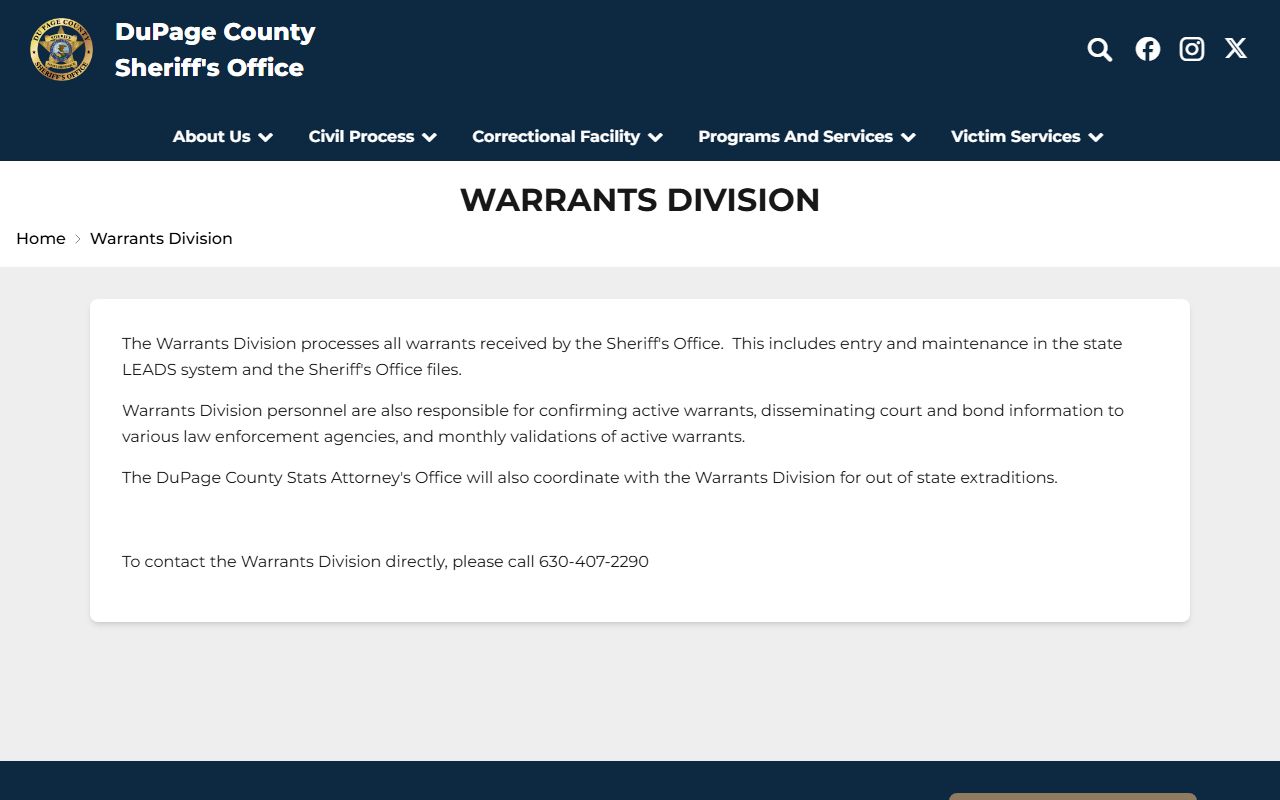
Outstanding DuPage warrants are tracked by the Sheriff's Warrants Division. The Sheriff's Warrants Division page covers active warrants, bench warrants, and the surrender process. For the deeper walkthrough, see the DuPage warrant records page.
Anyone who thinks a warrant may be active should call an attorney before walking into the courthouse or the jail.
Frequently Asked Questions
Are DuPage County Court records public?
Yes, in most cases. The Circuit Clerk's office says all DuPage circuit records are open during business hours, 8:00 a.m. to 4:30 p.m. Monday through Friday, unless a record is impounded or sealed by statute or court order. Remote online access is narrower than the access a person gets at the public terminals because of state privacy rules.
Where do I search DuPage County Court cases online?
The public path is the Circuit Clerk's Public Information Application at epay.dupagecircuitclerk.gov. Attorneys, police agencies, and self-represented litigants can request a free eAccess account for deeper search of active circuit cases that are not sealed, expunged, or juvenile-first-named-defendant files.
Who keeps DuPage County Court records?
Candice Adams, Clerk of the 18th Judicial Circuit Court. The Clerk keeps the court seal, attends court sessions, maintains records, and runs the public service desk at 505 N. County Farm Road in Wheaton. The office takes in more than 150,000 case filings each year across all DuPage divisions.
More questions and answers are on the DuPage County Court records FAQ page.