
Official DuPage County Court Records Portals
The Circuit Clerk runs two public-facing portals for DuPage court records. The Public Information Application is the open one. It supports payment of traffic tickets, civil law violations, balances due, and address changes, plus search for case status, the next court date, docket entries, and registration for traffic case email updates. The eAccess system is the second portal. It returns deeper case information but requires an approved account.
Illinois also runs a statewide reviewing-court portal called re:SearchIL. The state announced free remote public access through re:SearchIL for non-confidential reviewing-court documents filed in Illinois reviewing courts on or after April 1, 2025. The official announcement went out in 2025. re:SearchIL covers appellate-court filings, not the full DuPage circuit-court file on appeal.
DuPage is one of the Illinois counties on the E-Record program. The Illinois Courts E-Record page lists DuPage as an approved E-Record county and posts the approval date 06/27/14.
E-Record means the official record of a DuPage case is the electronic file, which lets the Clerk and the court work from the same digital docket.
DuPage County Court Records Search Fields
The Public Information Application landing page opens with a Cloudflare Turnstile check. A user must clear the check before the portal will show its search and payment options. The visible search controls on the public landing page include the buttons and links below.
| Field or Button | Type | Required | Notes |
|---|---|---|---|
| Cloudflare Turnstile "confirm you're not a robot" | Verification | Yes | Must clear before search. |
| Pay Traffic Tickets here | Link | Optional | Routes to traffic payment workflow. |
| Other Payments | Link | Optional | Routes to civil and balance payment workflow. |
| Search for your Case | Link | Optional | Allsearch case-lookup workflow. |
| Address Change | Link | Optional | Update mailing address for an active case. |
| Text or Email Reminders | Link | Optional | Sign up for court date alerts. |
Note: A search that fails to clear the Cloudflare check should be retried in a standard browser. If the check still fails, use the public terminals at the Clerk's office.
How to Search DuPage County Court Records Online
The fastest way to find a DuPage case is to walk the Public Information Application step by step. Have a name, case number, or citation number ready before opening the page.
- Open epay.dupagecircuitclerk.gov and clear the Cloudflare Turnstile check.
- Pick the workflow that matches the case type: traffic, civil law violation, balance payment, or general case search.
- Enter the party name or the case or citation number.
- Use date and case-type filters to narrow the result list.
- Open the case detail to see status, next court date, courtroom, docket, and any balance due.
- For sealed, juvenile, or older paper files that the portal does not show, visit the public terminals at 505 N. County Farm Road.
The Circuit Clerk's eAccess system serves users who need to see filings the open portal hides. The eAccess agreement excludes inactive, impounded, sealed, expunged, and juvenile-first-named-defendant cases. Approved attorneys can download free copies of signed orders within seven days of the file date.
Case Types in the DuPage Circuit Court File
The DuPage Circuit Clerk accepts more than 150,000 filings each year. The file breaks down across the standard Illinois case types. Each type has its own case-number letter code, which the Clerk uses to route the case to the right division.
- Felony (CF) - Charges that can carry a state prison sentence.
- Misdemeanor (CM) - Criminal cases with a maximum of a year in jail.
- Traffic (TR) and DUI - Citations, supervision, fines, and license-related dispositions.
- Civil law (LA) and civil municipal (LM) - Lawsuits over $10,000 and lawsuits up to that limit.
- Small claims (SC) - Money cases at or under $10,000.
- Chancery (CH) - Foreclosure, injunctions, administrative review.
- Domestic relations (D) and parentage - Divorce, custody, support, orders of protection.
- Probate (P) - Estates, wills, guardianships.
- Juvenile (JA, JD) - Abuse, neglect, and delinquency, with heavy access restrictions.
What Appears in a DuPage Court Record
A DuPage Circuit Court case file is built around a case number, parties, filings, docket entries, court dates, and orders. The exact fields vary by case type, but the table below shows what most users will see in the public detail view.
| Field | What It Shows |
|---|---|
| Case Number | Year, case-type letter code such as CF or TR, and a sequence number. |
| Caption | Plaintiff or petitioner versus defendant or respondent. |
| Filing Date and Case Type | Date the first pleading was accepted and the division code. |
| Courtroom, Judge, Next Date | Assignment data for the next scheduled event. |
| Docket Entries | Date-stamped record of filings, hearings, orders, and notices. |
| Financial | Filing fees, fines, restitution, bond, balance due. |
| Disposition | Outcome of a charge or claim. |
| Sentence or Judgment | Probation, supervision, fines, jail, or money damages. |
Personal identifiers such as Social Security numbers, full dates of birth, financial-account numbers, and minor names are redacted from the public view. Documents not viewable online may be inspected at the public terminals at the Clerk's office.
Public Access Framework
Illinois public access to court records rests on the Illinois Freedom of Information Act, the Illinois Supreme Court Rules, the Electronic Access Policy, the Clerks of Courts Act, and any local administrative orders signed by the Chief Judge of the 18th Judicial Circuit. FOIA covers most public bodies, but court files travel under court-record rules. Public terminal access at the Clerk's office is broader than the online portal because the state Electronic Access Policy limits what is published remotely.
The most important rule for a member of the public is Illinois Supreme Court Rule 8, Case and Document Accessibility. The rule presumes court documents are accessible unless a confidentiality classification applies. The court announced the rule in 2021 with an effective date of January 1, 2022.
The full rule set is online. The Illinois Supreme Court Rules index hosts every rule that touches access to a circuit-court file.
Rule 8 sits in that index along with the e-filing rules, the privacy rules, and the rules that govern how the Clerk transmits a record on appeal.
The Court's own news page summarized the change at the time of adoption. The official news release still serves as the plain-English explanation.
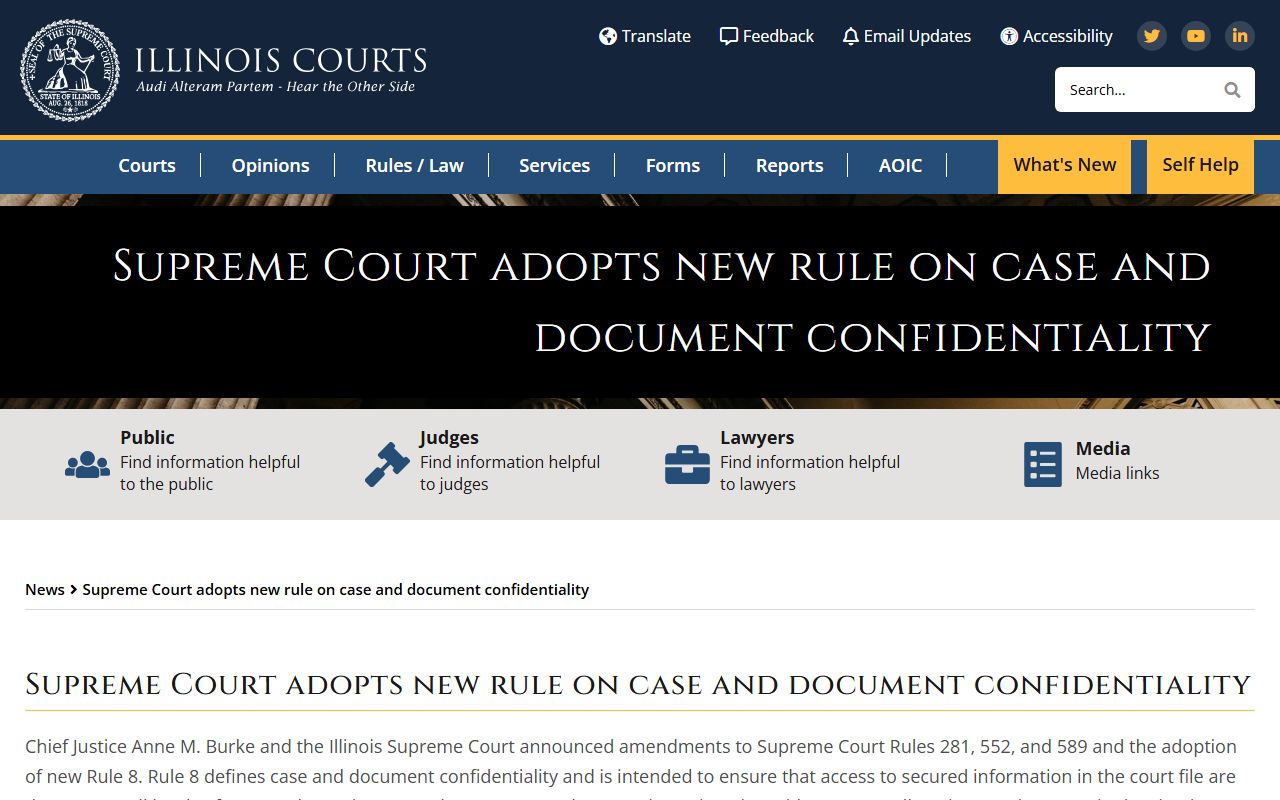
The release confirms the presumption of accessibility and lays out the categories of records that get restricted by classification.
Sealed, Impounded, and Confidential DuPage Records
The Circuit Clerk says all DuPage court records are public unless sealed or impounded by statute or court order. The most common restrictions hit juvenile delinquency, adoption, mental health proceedings, sealed search warrants, expunged arrest records, and sensitive family financial filings. Address information for protected parties under an order of protection is also restricted.
People who want a sealed or expunged file reopened must file a petition in the case where the records were closed. The Circuit Clerk has hosted free expungement clinics that pair volunteers with eligible residents to prepare petitions. Eligibility is governed by 20 ILCS 2630/5.2, the Criminal Identification Act.
Note: Confirm any DuPage court record detail with the Circuit Clerk before relying on it for a job, housing, or another court filing.