
DuPage Sheriff's Recently Released Inmates
The DuPage County Sheriff's site has a dedicated Recently Released Inmates page in the Corrections Bureau menu. The page is the county's first-party public source for short-window release information. Long-window release history is not on the county page; for older releases, use IDOC, BOP, or court docket lookups. The Sheriff also publishes a Records Division for older incident-report requests, including FOIA.
The roster also covers current custody, which helps confirm whether a person on the recently released list has cleared the building. Open the Sheriff's JailTracker roster to verify that an inmate is no longer in custody.

A person who was on the roster yesterday and is gone today is usually a recent release, a transfer, or a court-ordered move; the recently released page narrows the picture.
VINE Notifications
VINE, the Victim Information and Notification Everyday system, is the free official tool for custody-status alerts. The Sheriff links to VINE from the Corrections Bureau menu. Users register a phone, email, or TTY, then choose the inmate of interest. The system sends an alert when the inmate's custody status changes. VINELink is the national front end and covers Illinois.
| VINE Step | Detail |
|---|---|
| Select Illinois | VINELink asks for state at the start of the search. |
| Search by name or ID | Type the offender's name or known ID. |
| Open the record | Click the matching result to see current custody status. |
| Register notifications | Add phone, email, or TTY contact and a PIN. |
| Confirm enrollment | Save the PIN to manage future alerts. |
VINE alerts are a baseline service for crime victims; the Illinois Attorney General's Crime Victim Compensation program is a related state resource.
Note: A VINE alert is a notification, not a court order. Victims who need protective conditions still rely on the underlying court order from the Circuit Court.
Illinois Department of Corrections Release Search
People released from state prison are not on the DuPage Sheriff's list. IDOC keeps its own current and historical custody data. The state runs a current Individual in Custody Search plus a legacy search that still works for some historical records. The legacy site posts example dates and a maintenance note. Use both tools when the state has moved a person across facilities.
The legacy IDOC search is still a useful checker. Open the legacy IDOC individual in custody search for older record formats and example formatting.
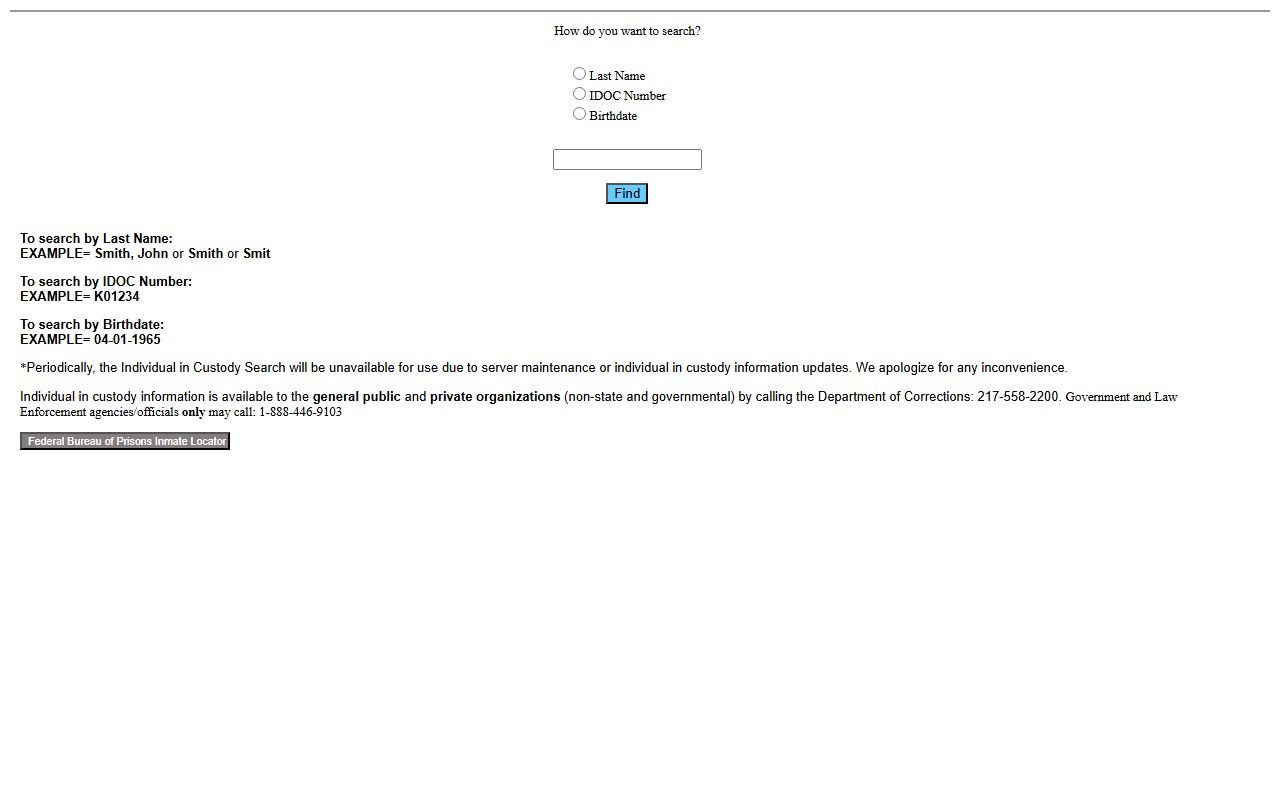
The new IDOC search is the better starting point for most current questions, with the legacy site as a fallback for older or migrated records.
Federal Bureau of Prisons Release Search
People released from federal custody are not in the county or state systems. The Bureau of Prisons runs the federal locator with two main paths: find by number and find by name. The find-by-number tab accepts BOP register, DCDC, FBI, or INS numbers. The find-by-name tab accepts first, middle, and last name and offers optional race, age, and sex filters. The BOP warns that release dates may change because sentences are reviewed and recalculated under First Step Act credits.
| BOP Field | Notes |
|---|---|
| Find By Number / Find By Name | One required. |
| Type of Number | BOP Register, DCDC, FBI, INS. |
| Number | BOP register number format such as 12345-678. |
| First name and Last name | Required on the name tab. |
| Race, Age, Sex | Optional filters in the name search. |
| Search / Clear Form | Submit or reset. |
The official federal locator is the first stop. Open the BOP inmate locator to query the federal release database.
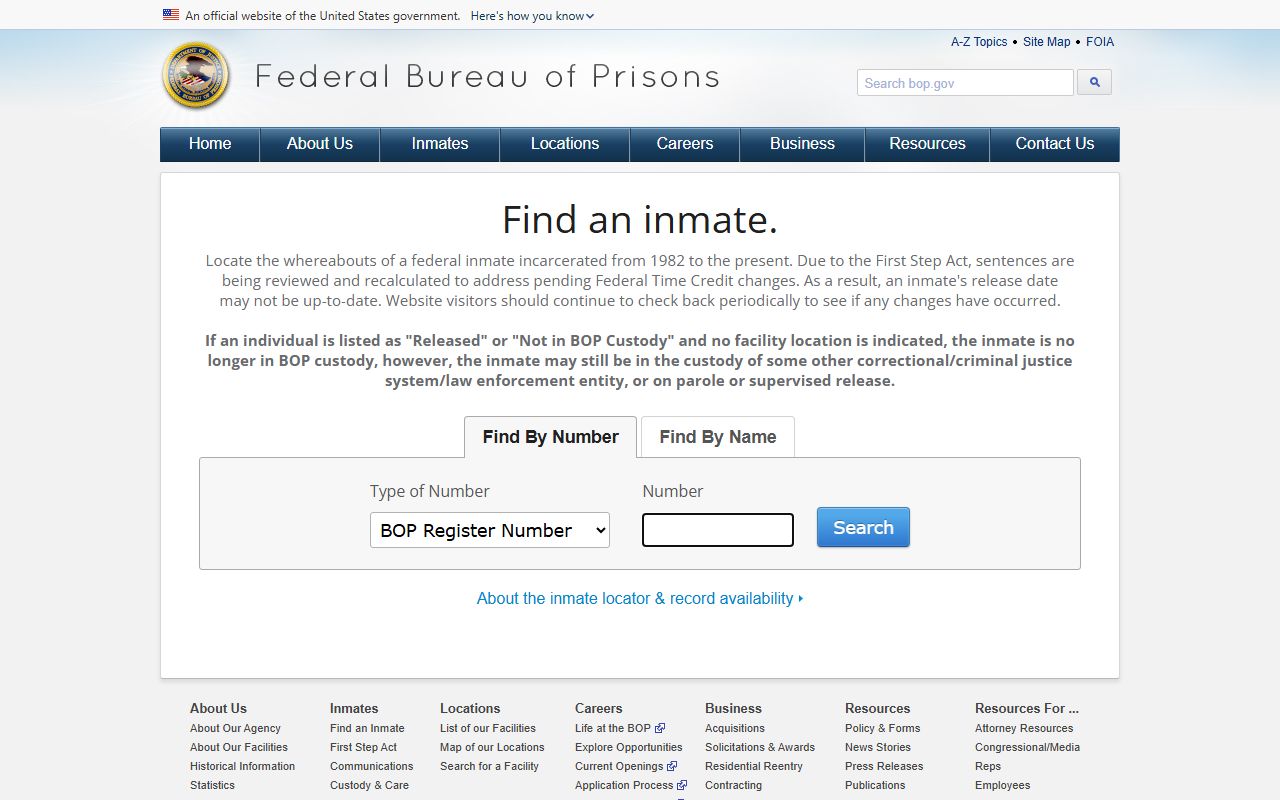
Sample BOP result columns are name, register number, age, race, sex, release date, and current location.
Parole and Mandatory Supervised Release
Illinois replaced traditional parole with Mandatory Supervised Release for most adult offenses. People released from IDOC custody typically serve a fixed term of MSR with conditions set by the Prisoner Review Board. The Prisoner Review Board hears parole-eligible cases on the older statutes, MSR violations, executive clemency petitions, and other matters. The DuPage Circuit Court does not run state parole. Questions about an MSR violation, an MSR condition, or a parole hearing go to the Prisoner Review Board rather than the Circuit Clerk.
People on local DuPage probation report to the 18th Judicial Circuit Probation Department. A violation in DuPage probation is filed back into the underlying case at the Circuit Clerk, and a violation warrant moves through the Sheriff's Warrants Division.
Verifying a DuPage Release
Several sources may need to align before a release is fully confirmed. The Sheriff's roster, the Sheriff's recently released page, the Circuit Clerk docket, and the VINE alert each tell part of the story. When two sources disagree, the official records win, and the Sheriff's records desk is the right call for a status conflict that needs same-day resolution.
- Check the JailTracker roster first; a person no longer listed has likely been released, transferred, or moved to another facility.
- Open the Sheriff's recently released page for short-window confirmation.
- Read the Circuit Clerk docket for the underlying case to confirm a release order or a pretrial release ruling.
- Check VINE for the formal status change alert.
- For state custody, search IDOC. For federal custody, search BOP.
- Call the Sheriff or the jail public line if web data still does not line up.
Bond Release and Pretrial Release
Illinois changed pretrial release with the Pretrial Fairness Act. Most DuPage release decisions now turn on a judicial release hearing rather than a cash-bond schedule. A person released after a hearing may have conditions such as electronic monitoring, no-contact orders, or substance testing. The Circuit Clerk's docket carries the release order and the conditions, and the Sheriff's roster shows the inmate as out of custody.
People who are released from county jail on a pending case still have court dates ahead. The Circuit Clerk's DuPage court dockets page is the place to confirm the next appearance after a release.
Sex Offender Registry After Release
People released after a conviction that triggers Illinois sex offender registration must register under 730 ILCS 150. The Illinois State Police runs the registry and publishes daily updates. The Sheriff also provides a public information page that links to the state registry and lists local awareness resources. Members of the public can search by name, city, or ZIP code.
Note: The state registry is the authoritative source; verify any third-party search against the ISP site before relying on it.
Reentry Resources in DuPage County
People released from custody face a long list of practical steps: housing, employment, transportation, identification, mental health, substance use, family contact, and court compliance. DuPage and Illinois have a network of programs that help. The Sheriff's site lists Mental Health Reentry, the Recovery Program, Medicated Assisted Recovery, and JUST of DuPage. Civil legal help is available through Illinois Legal Aid Online, Prairie State Legal Services, and the DuPage County Bar Association lawyer referral service.
- J.U.S.T. of DuPage - Faith, recovery, and reentry support tied to the Sheriff and the jail.
- Mental Health Reentry - Connects released inmates with mental health services.
- Medicated Assisted Recovery Program - Continued treatment for opioid use disorder.
- Prairie State Legal Services - Civil legal aid for low-income residents.
- Illinois Legal Aid Online - Statewide legal information and guided forms.
- DuPage County Bar Association - Lawyer referral and self-help resources.
Voting Rights After Release
People with felony convictions in Illinois regain the right to vote after release from incarceration. People held pretrial or under probation or parole are generally eligible to vote under state law. Voter registration goes through the DuPage County Clerk or the state's online portal. Confirm registration status before relying on it for a specific election.
Civil-rights restoration also includes the right to serve on a jury after the supervision period ends. Some firearms restrictions persist beyond release and require a separate process to restore eligibility under federal and state law.